
St. Mary outside of Pine Bluff, Arkansas, is the oldest church in Arkansas. It was originally built on a barge in the Arkansas River in 1782, during the American Revolution, before being moved to a site on land in 1832, 50 years later. But the story of the faith in the region goes back to the first Mass in 1541, then to 1686 when a permanent settlement was established at Arkansas Post by French fur traders. Over the centuries, various priests came and went, the people struggled to retain the faith, and the control of the land passed from one government to another. Stability came after the Louisiana Purchase in 1803, which made the region part of the United States, but that also brought a massive influx of Protestant settlers and preachers. By 1850, Catholics were a tiny minority in a land where they had been dominant. Also tied to St. Mary are the Sisters of Loretto and Mother Agnes Hart, who established a school in the region, before dying of malaria. Her remains were exhumed when St. Mary Church and its graveyard were moved in 1851 to avoid being washed away by the changing course of the Arkansas River. She was found incorrupt, and many believed her to be a saint. This pious belief was bolstered in 2007 when a man with terminal cancer was cured through her intercession. St. Mary fell into disrepair in the early 1900s when St. Joseph Parish in Pine Bluff took over the territory, but a 1927 restoration by a daughter of one of the old Catholic families of the region, ensured that it will remain cared for for years to come.
A note of thanks to our supporters, and an update on what's going on with us, the podcast, and pilgrimages...
We had a splendid time visiting The Willows, the home of Joseph Warren Revere, last weekend. It sits within Fosterfields Living Historical Farm outside of Morristown, New Jersey. We were in town for a wedding, and couldn't pass on the opportunity to see this historic home. And what a well-preserved bit of history it is!
The Foster family, who bought the house from Revere's widow, preserved a number of Revere's things, including the extensive trompe l'oeil paintings he did in the foyer and dining room.
If you're ever in the Morristown, NJ area we highly recommend you take the time to visit The Willows — and the rest of Fosterfields. They have additional museums on site, plus a working farm that preserves techniques and activities from 1920s farming. You also can pet the animals and take part in the work.
In 1819, Father Samuel Sutherland Cooper was shocked when the host in his hands suddenly changed into a piece of bleeding flesh. This happened in Augusta, Georgia, just a few days after Father Cooper had boasted that a demonstration proving the doctrine of Transubstantiation would take place on Sunday. His rash boast — and he recognized its rashness as soon as he'd proclaimed it — was in response to the abuse being hurled upon the Church, and especially upon the Real Presence of Christ in the Eucharist, by an ex-priest who still lived in the area. The remarkable happening naturally caused a sensation. Learn more about the remarkable life of Samuel Sutherland Cooper: https://americancatholichistory.org/samuel-sutherland-cooper/
Hello, and welcome to American Catholic History, brought to you by listeners like you. If you like our podcast, please become a supporter, rate us 5 stars, and give us a great review. I’m Noëlle Hiester Crowe, and I’m Tom Crowe.
Today we’re talking about Knute Rockne, the legendary Notre Dame player and coach, and how the example of young men going to Mass brought about his conversion.
There are few names as connected to the glory days of Notre Dame football as Knute Rockne. His success started as a player, and then really took off once he was head coach.
Well, Notre Dame football was nothing special before he came along. As a player at Notre Dame he was key in making the forward pass a formidable weapon in offensive play calling. And then, as coach, he led Notre Dame through a remarkable stretch of success.
But if you looked at his beginnings you wouldn’t have predicted any of it.
No, which makes his story really a quintessentially “American Dream” sort of thing.
Right: he was born in Norway in March 1888. Pretty much everyone in Norway at the time was Lutheran, and that included ...
In our efforts to get all of our back episodes back online we adjusted the script and re-recorded our episode on Fr. Juan de Padilla, the the first man to shed his blood for Christ in North America. We learned a few new details since we originally recorded this one, so while the story is largely the same it's a bit more accurate and informative..
This is one of the benefits of having to re-record many of these episodes: we can revisit in light of new developments, we can update our approach to the story telling, and we can overall improve on the stories that we share.
I hope you enjoy!
Prior to 2024, eleven national and international eucharistic congresses took place in the United States. The first was in 1895. What is a eucharistic congress? What gave rise to them? What happens at them? We talk about these questions and give some highlights from a number of the congresses of the past. Listen in!
Welcome to all our new members and supporters! Thank you for being here. We hope that you find the community enjoyable, supportive, and informative.
If you're new to Locals, a few notes on how this works.
Members can view posts (except supporter only posts) and like posts.
Supporters can view all posts, like posts, comment on posts, and create posts.
We hope those who are supporters will comment and post. The more people participating in the forum, the more interesting it is for everyone!
Who are supporters? Those who support our work with at least $5 each month. We actually have a great line-up of perks for supporters:
$5/month: access to all our "Supporter-Only" content. We've been working hard at developing some new content beyond our weekly podcast. Each month we plan to release a video in our new "American Catholic History On Location" series, taking you to American Catholic places near and far. Look out for our inaugural video tomorrow!
We also will be releasing longer-form interviews ...
We're publishing our episodes here on Locals, as well as on Patreon and Substack, in an ad-free format for paid supporters. Our posts on platforms like Apple, Spotify, Amazon, Pandora, etc., will have ads, but supporters on these platforms will have the opportunity to listen without ads.
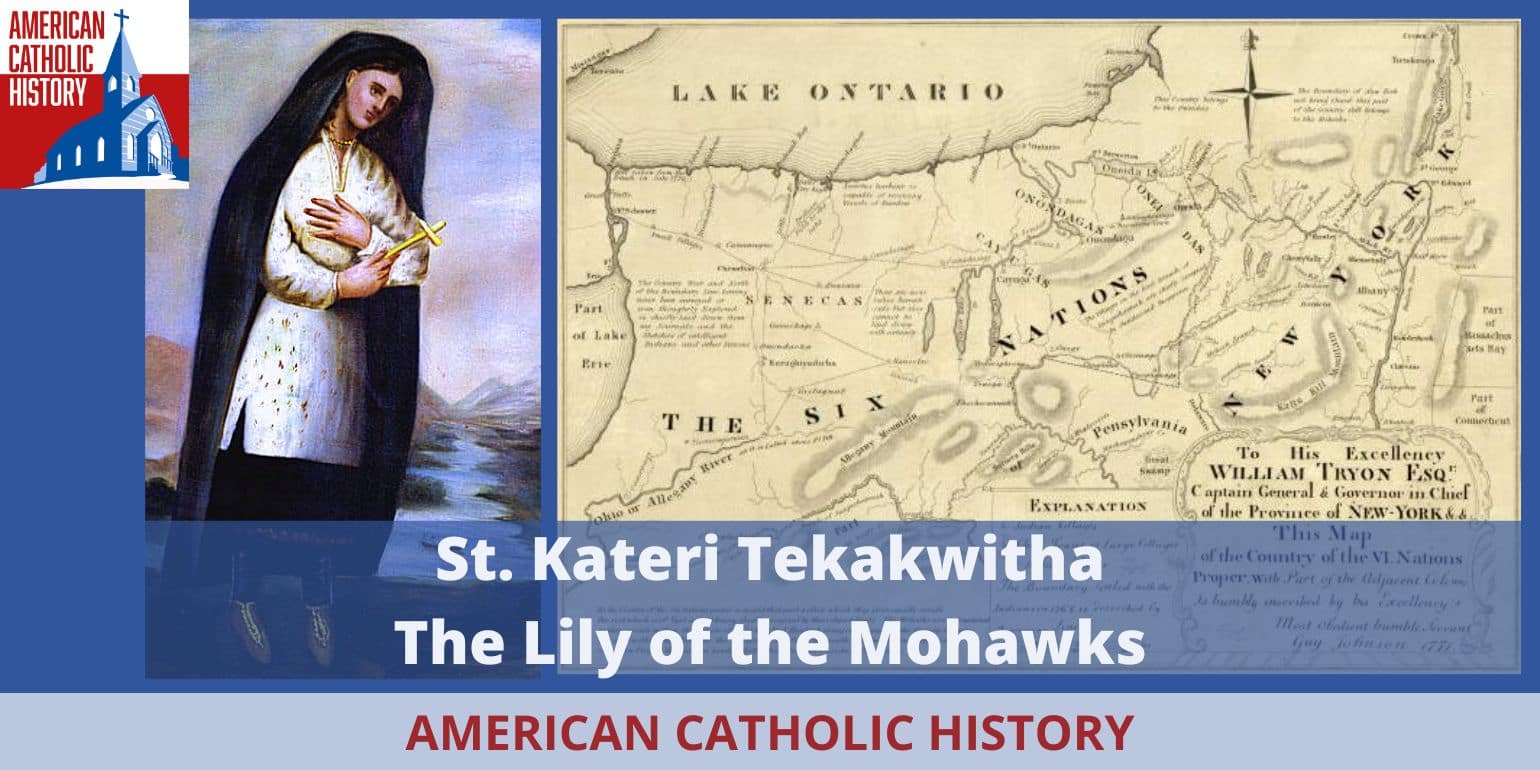
Today is the feast of St. Catherine of Siena, the 14th century mystic and reformer. She doesn't have a direct connection to American Catholic History, except that the first Native American woman to be canonized took St. Catherine's name when she was baptized. St. Kateri Tekakwitha was originally given the name "Tekakwitha," which means "She Who Bumps Into Things," by her Mohawk tribe. But when she converted to Catholicism at 19 years old, she took on the Mohawk form of the name "Catherine," which is "Kateri." The only question (admittedly a minor question, compared to how humble and devoted a life she led and what a great example she left us) is how to pronounce it. Most say "kuh-TEER-ee," but some in New York believe it would have been "CAT-er-ee" in the original Mohawk pronunciation.
Either way, the most important thing is that eventually we were able to call her "saint."
St. Kateri Tekakwitha, and St. Catherine of Siena, pray for us!
...